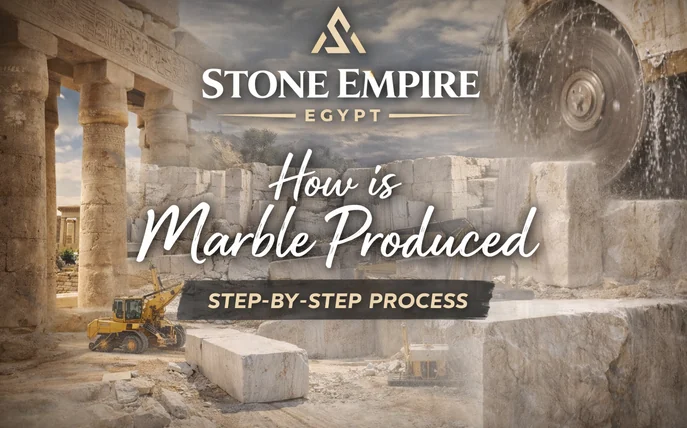
Marble can make any space feel instantly premium, but that flawless slab didn’t happen by luck. How is marble produced is the story of careful control from the very first quarry cut to the final finished surface, so the stone keeps its natural beauty while avoiding the common headaches: cracks, chipped edges, uneven thickness, and noticeable shade differences across a project.
How Is Marble Produced
A key part of how is marble produced is understanding Different Grades of Marble. After extraction, marble blocks and slabs are graded based on structural integrity and visual consistency. This grading determines whether material is best suited for premium large slabs, general flooring and wall cladding, or smaller cut-to-size and tile production, helping Stone Empire Egypt deliver the right marble quality for the right application.
High-quality production is about controlling five things:
- Block orientation: cutting with the natural structure to reduce breakage
- Handling discipline: preventing chips and stress cracks before cutting even starts
- Thickness + flatness: so slabs install cleanly and finish evenly
- Sorting + batching: so a floor or feature wall doesn’t look patchy
- Surface uniformity: consistent polish/hone with no dull areas
Explore our Egyptian marble gallery.
Extraction of Marble Blocks
At Stone Empire Egypt, the production journey starts at the quarry because the way a block is extracted decides everything that comes after. Marble isn’t uniform like manufactured materials; it has natural veining, colour zones, and structural lines. That’s why our focus is to extract blocks in a controlled way that protects both strength and appearance, especially for popular Egyptian marbles
How Stone Empire Egypt approaches block extraction
- Deposit assessment first: We study vein direction, colour variation, and natural weak lines to choose the best cutting orientation. This helps reduce breakage and improves slab consistency later.
- Planned block layout: Blocks are mapped and marked to maximise usable yield and avoid unstable zones—so fewer surprises appear during slab cutting.
- Controlled separation: Blocks are separated using methods designed to minimise vibration and stress on the stone, helping prevent hidden fractures that could open up during processing.
- Careful lifting and handling: Extracted blocks are lifted with proper support to protect corners and reduce bending stress along natural veins.
- Initial quarry grading: Before blocks move to processing, we inspect them for cracks, open veins, weak corners, and overall pattern behaviour then assign them to the right use case (large slabs, tiles, or cut-to-size).
This quarry-first quality control is what helps Stone Empire Egypt deliver marble that’s easier to process into consistent slabs, safer to fabricate, and more reliable for real-world installations.
Arrival and Unloading
Transport is a hidden source of defects. Many slab-edge chips and stress fractures begin here, not during polishing.
What careful unloading looks like
1-Correct lifting supports protect corners and prevent bending stress.
2-Blocks are labelled for traceability (helps batching and project matching).
3-Blocks are stored on stable supports to avoid pressure points.
4-A second inspection checks for transport damage before cutting starts.
Cutting Marble Blocks into Slabs

Cutting is where a block becomes usable slabs and where hidden weaknesses often reveal themselves. The goal is consistent thickness, minimal chipping, and clean sorting for matching.
How factories cut blocks into slabs
1-Blocks are sliced into slabs using industrial systems such as gang saw lines and/or diamond wire systems.
2-Cooling (often water-assisted) reduces heat stress and helps achieve a cleaner cut.
3-Slabs are handled with supports to protect edges and reduce breakage.
thickness control
Even a small thickness variation can cause:
1-uneven lippage during installation
2-inconsistent polishing/honing results
3-Difficulty in edge fabrication for cut-to-size work
The “sorting moment” (this is where projects are won or lost)
Right after cutting, slabs are typically sorted by:
1-tone and shading
2-vein direction and pattern strength
3-natural features (pits, open veins, fissures)
4-suitability (feature slabs vs general use vs tile conversion)
Stabilisation and preparation (only when needed, but decisive)
- Resting/drying: reduces moisture-related patchiness during finishing
- Resin treatment: stabilises open veins, pits, and micro-cracks
- Reinforcement (when required): added support for fragile slabs or formats
- Calibration: levels, thickness and flatness for cleaner installation and more even finishing
how marble is made in factory?
Here’s the complete production chain in one clear sequence:
1-Quarry assessment and planning (veins, colour zones, block layout)
2-Controlled extraction and careful lifting
3-Quarry grading (structure + tone suitability)
4-Transport, safe unloading, stable storage, and second inspection
5-Primary cutting into slabs with cooling and thickness control
6-Slab sorting and batching for tone/vein consistency
7-Resting/drying when needed
8-Resin treatment and reinforcement when required
9-Calibration and surface preparation
10-Finishing (polished/honed/textured depending on the target look and use)
11-Quality control and grading (dimensions, surface uniformity, edge integrity)
12-Protective packaging and shipping
Call us now to get an egyptian marble
Conclusion
So, how is marble produced? It’s a controlled journey from quarry block to finished slab—where the biggest quality differences come from correct block selection and orientation, careful handling, accurate cutting, stabilisation when needed, consistent finishing, strict grading, and protective packaging.
Frequently Asked Questions